Mortgage on off-plan properties in Dubai
2026-08-12
856 Views
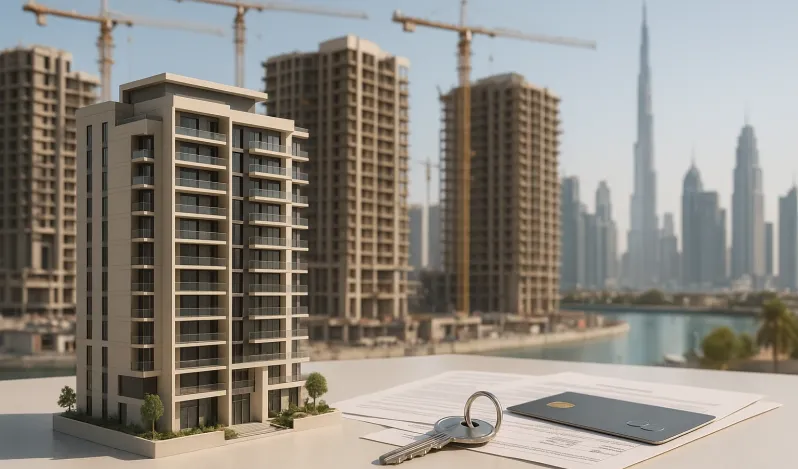


Buying an off-plan property in Dubai does not necessarily mean paying the full value of the property from your own funds, but financing this type of property is fundamentally different from financing a ready property. The bank does not only look at the buyer’s financial ability, but also at the project itself, the developer, the stage of construction, and the financing conditions related to it. In other words, buying a unit off-plan with a payment plan from the developer does not automatically mean that the bank will finance it.
- Is it possible to get a mortgage for an off-plan property in Dubai?
- How does a mortgage work for off-plan properties in Dubai?
- What are the conditions for financing off-plan properties in Dubai?
- What is the financing percentage for off-plan properties in Dubai?
- What documents are required to obtain financing?
- Steps to obtain a mortgage for an off-plan property in Dubai
- Mortgage or developer payment plan: Which is better?
- What is the difference between financing a ready property and an off-plan property?
- What are the costs of a mortgage for an off-plan property?
- How to choose the right off-plan property for purchase with financing?
- Is financing off-plan properties suitable for investors?
- Finance your off-plan property purchase in Dubai with the help of Imtilak Global
This article explains when it is possible to obtain a mortgage on off-plan properties in Dubai, the conditions and required down payment, how the financing mechanism works in practice, and the difference between it and ready property financing.
Is it possible to get a mortgage for an off-plan property in Dubai?
Yes, it is possible to finance some off-plan properties in Dubai, but not every project or unit is automatically eligible for bank financing.
Several combined factors control this:
The buyer’s eligibility for financing (income, obligations, credit history).
Approval of the project and developer by the concerned bank.
The stage of project construction progress.
The bank’s policy and the conditions of the specific financing product.
The property value and the payments already made to the developer.
It is important to distinguish here between the possibility of buying an off-plan property with a payment plan offered directly by the developer, and obtaining an actual mortgage from a licensed bank; these are two different legal and financial paths.
How does a mortgage work for off-plan properties in Dubai?
The financing mechanism usually does not start from day one of purchasing the unit but is linked to the project’s payment schedule and stage of completion.
Initial payments to the developer - In most cases, the buyer is required to cover part of the unit’s value from their own funds in the early stages, according to the payment schedule agreed upon with the developer, before bank financing comes into play.
Reaching the eligible stage for financing - The timing of the bank’s involvement in the financing process varies from one project to another and from one bank to another, depending on the required completion percentage and the agreement between the bank and the developer.
Disbursement of financing and completion of payments - The approved financing is usually not disbursed as a direct cash amount to the buyer but is directed according to a specific mechanism to cover the payments due to the developer as per the conditions agreed upon between the bank and the project.
You may be interested: Real Estate Financing in Dubai
What are the conditions for financing off-plan properties in Dubai?
The conditions are divided into two main aspects that must be met together.
Conditions related to the buyer:
Age at the start and end of financing.
Level and stability of income.
Existing financial obligations.
Credit history.
Nature of work and employer.
Residency or non-residency in the UAE.
Conditions related to the project and property:
Legal status of the project.
Registration of the project and unit according to the procedures in place at the Dubai Land Department.
Reputation and track record of the real estate developer.
Actual stage of project completion.
The project’s eligibility for financing with the concerned bank, regardless of the buyer’s eligibility.
The buyer’s eligibility for financing does not necessarily mean that the chosen project or unit is eligible for financing from the same bank.
What is the financing percentage for off-plan properties in Dubai?
This percentage is known as the loan-to-value ratio (LTV), which is the portion the bank can finance from the unit’s value, while the buyer covers the rest from their own funds.
According to the UAE Central Bank Circular No. 31 of 2013 regarding mortgage loan rules, maximum financing ceilings are set according to the buyer category (citizen or resident), property value, and purpose of purchase (first home or investment), with a usually lower ceiling for financing off-plan properties compared to ready properties, due to the higher risks associated with the construction phase.
Practically, the actual percentage approved by the bank varies according to:
Factor | Impact on Financing Percentage |
Buyer category (citizen/resident/non-resident) | Determines the highest regulatory ceiling allowed |
Property value | Higher-value properties may get a lower financing percentage |
Purpose of purchase (first home or investment) | Investment usually gets a lower percentage than a first home |
Project completion stage | The earlier the project, the more cautious banks are in financing |
Buyer’s financial solvency | Affects the final approval within the allowed ceiling |
These percentages are subject to periodic updates by the UAE Central Bank and to the credit policy of each bank, so it is advised to check the actual percentage available at the time of application directly from the bank.
What documents are required to obtain financing?
For residents, documents usually include:
UAE ID.
Passport and valid residence page.
Proof of income (salary letter or income statements).
Bank statements for a specified period.
Proof of employer or business activity.
Unit and project documents (sales contract, initial registration/fuel data).
For non-residents: The documents and requirements vary depending on the bank, nationality, and source of income, which is a broader topic that deserves a separate explanation; for full requirements, you can refer to the article Real Estate Financing in Dubai for Foreigners.
Steps to obtain a mortgage for an off-plan property in Dubai
Determine the total budget and actual repayment ability.
Obtain a preliminary (pre-approval) assessment of personal financing eligibility.
Select a project and unit that are eligible for financing from the outset.
Check the target bank’s conditions and its policy towards the specific project.
Prepare the required documents and officially submit the financing application.
Have the property evaluated by an accredited entity, then obtain final approval when the project reaches the appropriate stage.
Complete the procedures for disbursing the financing and payments as agreed with the bank and developer.
Complete the procedures for registering ownership and mortgage with the Land Department according to the project status (Oqood system before completion, or Title Deed after handover).
Mortgage or developer payment plan: Which is better?
Element | Bank Financing (Mortgage) | Developer Payment Plan |
Financing provider | Bank | Developer |
Credit check | Usually required | Varies by developer |
Repayment period | Can be longer (even years after handover) | Often shorter, linked to construction period |
Financing cost | Clear interest/profit margin | Depends on developer offer, sometimes with no apparent interest |
Flexibility | Depends on bank policy | Depends on project and developer conditions |
Down payment | According to allowed financing percentage (LTV) | According to developer’s payment schedule |
There is no absolute better option; the choice depends on the buyer’s available liquidity, preferred repayment period, the cost of each option, and the purpose of purchase (home or investment). Some buyers prefer the developer’s plan to avoid early bank financing procedures, while others prefer bank financing to preserve their own liquidity.
What is the difference between financing a ready property and an off-plan property?
The main differences are:
Timing of financing disbursement: Relatively immediate for ready properties, and linked to the construction stage for off-plan properties.
Property readiness and evaluation: Evaluation of a ready property is clearer, while evaluation of an off-plan property depends on project documents and completion percentage.
Project conditions: Financing an off-plan property adds the condition of project and developer approval, which is usually not required for ready properties.
Potential financing percentage: Usually lower for off-plan properties due to higher risks.
Required self-contribution: Usually higher for off-plan properties.
Risks associated with the construction phase: Not present in ready properties at all.
What are the costs of a mortgage for an off-plan property?
The cost is not limited to the interest rate or profit margin only, but usually includes:
Interest or profit rate on the financing.
Financing application processing fees at the bank.
Property evaluation fees, if applicable.
Mortgage registration fees at the Land Department.
Other related banking and administrative fees.
Insurance costs (life or property) if required by the bank.
Property purchase fees and procedures themselves, separate from financing fees.
These percentages or amounts are not fixed for all cases or banks, and it is always advised to check the actual fees in effect at the time of decision, whether from the concerned bank or from the relevant official authorities.
How to choose the right off-plan property for purchase with financing?
Selecting the right unit for financing starts with ensuring that the project itself is approved by major banks, and that the developer has a clear delivery record, in addition to matching the budget and expected financing percentage. To browse off-plan projects within different price ranges and areas, you can check the list of Top 10 Off-Plan Projects in Dubai.
Is financing off-plan properties suitable for investors?
For the investor, financing presents a different balance than for a buyer for residential purposes:
Preserving part of the liquidity instead of freezing it in a single property.
Using financial leverage to increase investment capacity.
Comparing financing cost versus expected rental or capital return.
Paying attention to the risks of relying too much on future property value increases.
The importance of calculating the actual return after deducting financing costs, not before.
For those who want to delve deeper into this aspect, you can refer to the article Return on Real Estate Investment in Dubai.
Finance your off-plan property purchase in Dubai with the help of Imtilak Global
Selecting the right project for financing, comparing different developer payment plans, and understanding the available purchase options are steps that require careful study before committing to any contract. The Imtilak Global team helps the buyer choose projects suitable for their budget, compare available payment plans, clarify possible purchase and financing options, and coordinate throughout the various purchase stages, enabling the investor or buyer to clearly compare the options before making a decision.
To get a consultation about off-plan properties in Dubai and suitable purchase options for your budget, You can contact the Imtilak Global team.
Do you like this topic? You can share it with your friends now!


Do you like this topic? You can share it with your friends now!