Buying property in Dubai for non-residents
2026-08-12
850 Views



Non-residents are not required to obtain a UAE residency in advance to buy property in Dubai. The real estate market in Dubai is open to investors of various nationalities within designated freehold areas. However, not residing in the country may affect the type of documents required, available financing options, the process of transferring funds, and banking procedures related to the transaction. This article explains the practical conditions that an investor residing outside the UAE needs to know before purchasing, from eligibility for ownership to documents, costs, and registration steps.
- Can a non-resident buy property in Dubai?
- Who is considered a non-resident when buying property in Dubai?
- What are the conditions for buying property in Dubai for non-residents?
- What documents are required from a non-resident buyer?
- Documents for cash purchase
- Documents for mortgage purchase
- Can a non-resident obtain a mortgage in Dubai?
- Does a non-resident need a bank account in the UAE?
- How does a non-resident transfer the property price to Dubai?
- Steps to buy property in Dubai for non-residents
- What costs should a non-resident consider?
- Does buying property grant a non-resident residency in the UAE?
- Buy your property in Dubai from abroad with the help of Imtilak Global
Can a non-resident buy property in Dubai?
Yes, a non-resident can buy property in Dubai without the need for UAE residency, provided the property is within a designated freehold area or project.
Dubai allows foreigners, whether residents or non-residents, to own properties located in approved areas without requiring prior residency as a prerequisite for purchase. However, it is important to distinguish between three separate matters: eligibility for ownership itself, obtaining a mortgage from a bank, and qualifying for residency linked to the property later; fulfilling the first condition does not necessarily guarantee the other two automatically.
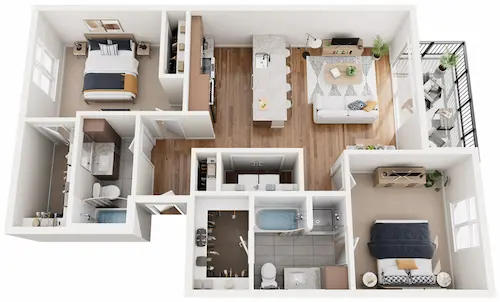
How many living rooms are in the apartment?

To learn about the legislative framework that underpins the right of foreign ownership in Dubai, you can refer to Property Ownership Law for Foreigners in Dubai.
Who is considered a non-resident when buying property in Dubai?
In the context of property purchase, a non-resident is someone who does not hold a valid UAE residency visa at the time of the transaction, regardless of nationality.
This distinction is important because the term “foreigner” is broader than “non-resident”; a person may be a foreign national but reside in the UAE under a work, investment, or family visa, while a non-resident lives outside the country permanently and does not hold any residency permit. This difference is practically reflected in several procedural and banking aspects, as shown in the following table:
Criteria | UAE Resident | Non-resident |
Ownership eligibility | Available in freehold areas | Available in freehold areas |
Mortgage | Wider options at some banks | Available at some banks with stricter conditions |
Income proof | Usually via salary or documented local activity | Based on foreign income documents, as per bank policy |
Banking procedures | Opening an account and regular local transfers | International transfers; may need to open an account if required |
Transaction execution | Usually in-person attendance | Attendance, power of attorney, or remote channel as available |

These differences are descriptive and not fixed rules that apply to every case, as policies vary from one bank or developer to another.
You may also be interested in: Freehold Areas in Dubai for Foreigners
What are the conditions for buying property in Dubai for non-residents?
The basic conditions are to choose a property eligible for foreign ownership, provide valid identification documents, and meet financial verification requirements when needed.
The most notable conditions include:

Selecting a property within an area or project where foreign ownership is permitted.
Providing a valid passport as the main identity document.
Proving the source of funds when requested by the bank, developer, or broker.
Meeting the requirements of the financing entity if purchasing through mortgage.
Signing the transaction documents, from reservation form or sale agreement to the final sale contract.
Completing registration and financial verification procedures with the relevant authorities.
These conditions do not differ fundamentally from the general conditions for foreign ownership in Dubai, but they are applied to non-residents with additional considerations related to their place of residence and external document authentication.
What documents are required from a non-resident buyer?
Documents for cash purchase
A non-resident buyer making a cash purchase needs a basic set of documents, including:
Get a free real estate consultation
What is your preferred way of communication? How would you like to be contacted?

Get a free real estate consultation
Choose the appropriate day for us to contact you
A valid passport.
Residence and contact details in the current country of residence.
Proof of source of funds, when requested by the bank or relevant authority.
Bank account details from which the transfer will be made.
Contract and registration documents for the selected property, whether ready or under construction.
Documents for mortgage purchase
When using a mortgage, banks usually require additional documents related to the borrower's financial capability, such as:
Proof of income or employment, such as a salary letter or business activity documents.
Bank statements for a period specified by the bank.
Documents of existing financial obligations.
Credit report, or alternatives accepted by the bank if no local credit history exists.
These requirements vary depending on the bank, buyer’s nationality, country of residence, and the type of transaction. Therefore, it is recommended to communicate directly with the bank or financing entity to confirm the exact list before starting the process.
Start a chat
Talk to us on your favorite channel







Can a non-resident obtain a mortgage in Dubai?
Yes, a non-resident can obtain a mortgage in Dubai, but this is subject to each bank’s policy and is not a guaranteed right for every applicant.
Banks consider several factors when reviewing a mortgage application, including income, age, nationality, country of residence, and existing financial obligations. Therefore, approval and conditions vary from person to person, even within the same nationality or country.
It is advisable for non-residents to obtain preliminary mortgage approval before making a serious purchase offer, as it gives a realistic picture of their purchasing power and speeds up the signing process later. Also, costs of property valuation, insurance, and financing fees should be included in the overall budget, as they are usually added to the property value and not included in it.
Does a non-resident need a bank account in the UAE?
Are you ready to invest? Which apartment type do you prefer?
 Studio
 One bedroom
 Two bedrooms
 3 bedrooms or more
Select region
Opening a bank account in the UAE is not a fixed requirement for every non-resident buyer, as the need for it depends on the payment method, bank, developer, and the nature of the transaction.
For cash purchases through direct international transfer, some developers and brokers may accept the transfer from the buyer’s account abroad without requiring a local account. However, if obtaining a mortgage from a UAE bank, the bank will usually require opening an account to complete the disbursement and repayment procedures. Therefore, the matter varies between international cash transfer and local financing, and opening an account cannot be considered a guaranteed or automatic result of every purchase.
Read more about: How and Conditions to Open a Bank Account in Dubai
How does a non-resident transfer the property price to Dubai?
The property price is usually transferred via international bank transfer from an account belonging to the buyer to the account or escrow account specified in the contract.
Practical points to consider when transferring:
The transfer should be from a bank account in the buyer’s name or the owning company for the transaction.
Verify the beneficiary’s details before making any transfer.
Keep all proof of transfers and payments for future reference.
Consider exchange rate differences and intermediary bank fees that may be deducted from the transferred amount.
Provide proof of source of funds when requested by the bank or developer.
Avoid transferring to personal accounts that are unverified or not officially linked to the transaction.
Verify the escrow account dedicated to the project when buying an off-plan property, and ensure that transfers are made directly to it according to the approved payment plan.
Steps to buy property in Dubai for non-residents
The purchase process for a non-resident goes through the following steps:
Determine the purchase objective and total budget.
Ensure ownership is permitted in the selected area.
Select the property and verify its legal and construction status.
Choose the payment method or obtain preliminary mortgage approval if needed.
Submit the offer and review the transaction terms.
Sign agreements and pay the required installments.
Complete approvals, registration, and transfer of ownership.
Receive the property or appoint a management entity.
How many living rooms are in the apartment?
If the buyer cannot be present to complete these steps personally, some can be carried out through a power of attorney or remotely, as detailed in the article Buying Property in Dubai Remotely, which explains the mechanism for power of attorney, electronic signing, and receiving through a representative.
What costs should a non-resident consider?
A non-resident needs to consider a set of costs in addition to the property value itself when planning the budget, including:
Property value and down payment.
Registration and transaction fees with the relevant authorities.
Real estate brokerage commission.
Financing and valuation costs if borrowing.
Annual property service fees.
Money transfer costs and currency exchange differences.
Power of attorney and notarization costs if the transaction is executed through a representative.
Management and maintenance costs after purchase.
You may also be interested in: Costs of Buying Property in Dubai
Get a free real estate consultation
What is your preferred way of communication? How would you like to be contacted?
Get a free real estate consultation
Choose the appropriate day for us to contact you
Does buying property grant a non-resident residency in the UAE?
No, property ownership does not automatically grant a non-resident UAE residency; ownership and residency are legally and procedurally separate tracks.
The buyer's eligibility for property-linked residency remains subject to fulfilling the official requirements in force at the time of application, which may include conditions related to the property’s value, type, and payment status. For details on these requirements, refer to the article Buying Property in Dubai and Obtaining Residency.
Buy your property in Dubai from abroad with the help of Imtilak Global
A non-resident investor faces several simultaneous decisions when buying from abroad, from choosing the right property to arranging financing, transfers, and registration. The Imtilak Global team assists clients in:
Identifying properties that suit their goals and budget.
Comparing ready and off-plan properties.
Providing verified property and developer information.
Coordinating viewings and consultations before making a decision.
Following up on offers, contracts, and registration procedures step by step.
Coordinating handover and property management when needed.
Contact Imtilak Global consultants for well-studied property options and follow-up on the process of buying your property in Dubai from selection to registration and handover.
Do you like this topic? You can share it with your friends now!


Do you like this topic? You can share it with your friends now!
Need real estate help?
Consult with our specialist

More From Imtilak