Partial property ownership in Dubai: How does it work and what does the investor own?
2026-09-17
78 Views
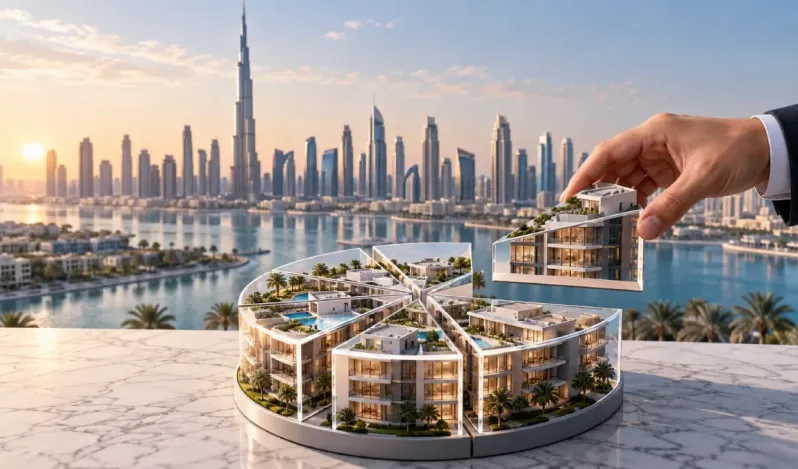


Buying a full property in Dubai requires capital that may not be available to every investor, especially in high-value projects and prime locations. This has led to the emergence of modern investment models that allow entry into the real estate market by purchasing a share of the asset instead of buying it outright.
Fractional property ownership means that the investor owns a specified share of a real estate asset instead of buying the entire property, so that ownership and the economic value of the property are distributed among multiple investors according to the legal and investment model used.
- What is fractional ownership of real estate in Dubai?
- A simple example of partial ownership of property
- How does fractional ownership of real estate work in Dubai?
- What does the investor get for their share?
- Is fractional ownership of real estate legal in Dubai?
- What is the role of the Dubai Land Department?
- Fractional ownership and real estate tokenization in Dubai: what is the relationship?
- What is the difference between fractional ownership and joint ownership of property?
- Fractional ownership or buying a full property in Dubai?
- What are the potential returns from partial investment in Dubai real estate?
- What are the advantages of fractional ownership of real estate in Dubai?
- What are the risks and disadvantages of partial real estate investment?
- How do you assess a fractional ownership opportunity before investing?
- Can foreigners invest in fractional ownership in Dubai?
- Is fractional ownership suitable for real estate investment in Dubai?
- Explore real estate investment opportunities in Dubai with Imtilak Global
However, the form of the legal right, the method of registration, and how the share is handled differ depending on the product and platform, so not every offer labeled as Fractional Ownership should be treated the same way before verifying its structure.
What is fractional ownership of real estate in Dubai?
Fractional ownership is an investment model that allows more than one investor to own shares in a single real estate asset instead of owning it individually. Each investor's share of operating income and any potential increase in the value of the asset is linked to the size of their share, according to the terms of the product through which they invested.
How many living rooms are in the apartment?

It is important not to assume that every fractional ownership grants its owner a traditional, independent title deed in their name; the nature of the right is determined by the legal structure of the product, as will be explained later.
A simple example of partial ownership of property
To illustrate the idea for educational purposes only: a property worth two million dirhams can be divided into multiple investment shares, so that each investor owns a specific percentage of the asset. Their economic share and potential return are linked to this percentage, according to the terms of the product used, without necessarily meaning they own a specific physical part of the property.
Does partial ownership mean owning a full apartment in Dubai? No. The basic idea is to own a share of a real estate asset or the rights associated with it according to the investment structure, and not necessarily to own a full residential unit individually.
How does fractional ownership of real estate work in Dubai?
The process generally follows sequential steps: selecting the property or investment opportunity, determining the value of available shares, purchasing the desired share, documenting the right according to the approved legal model, managing the property by a specialized entity, distributing potential returns to investors, with the possibility of exiting the investment according to pre-defined conditions.

What does the investor get for their share?
The answer depends specifically on the legal structure of the product, so the investor should verify several elements before investing:
The nature of the right actually being purchased
The mechanism to prove this right
The entity regulating the product or platform
The terms for distributing income generated by the property
The party responsible for managing the asset
The method for selling the share or exiting the investment
Is fractional ownership of real estate legal in Dubai?
The Dubai Land Department is working on an official real estate tokenization project, launched in cooperation with the Virtual Assets Regulatory Authority (VARA), Dubai Future Foundation, and the Central Bank of the United Arab Emirates, as part of the REIS initiative for real estate innovation. The project aims, among its objectives, to enable several investors to own joint shares in a single property, expanding access to real estate investment.
However, it is important to clearly distinguish between official models that allow fractional ownership under the supervision of competent authorities, and assuming that any commercial offer labeled as Fractional Ownership is automatically approved by official bodies. Verifying the licensing of the product operator is a basic step before any investment.
What is the role of the Dubai Land Department?
The Dubai Land Department (DLD) is responsible for regulating and registering real estate rights in the emirate, overseeing initiatives that enable new ownership models such as real estate tokenization, in addition to its traditional responsibilities in registering property transfers and issuing title deeds. For more details on the registration process, see property registration procedures in Dubai.
Fractional ownership and real estate tokenization in Dubai: what is the relationship?
Fractional ownership is a broader economic and legal concept, referring to the distribution of investment or ownership in a single real estate asset among multiple investors, regardless of the technical mechanism used to achieve this.
Real estate tokenization is one of the digital mechanisms through which shares in a real estate asset can be represented using blockchain technology. The Dubai Land Department explains that tokenization turns real estate assets into digital tokens, allowing the asset to be divided into shares according to the investor's budget and investment strategy.
In this sense, the two terms should not be used interchangeably: tokenization is one possible model for enabling fractional ownership, not a substitute definition.
Get a free real estate consultation
What is your preferred way of communication? How would you like to be contacted?

Get a free real estate consultation
Choose the appropriate day for us to contact you
Does every fractional ownership depend on real estate tokenization? No. Tokenization is one of the models that can enable fractional ownership, and there may be other models for distributing investment in the asset that do not necessarily rely on blockchain technology or digital tokens.
What is the difference between fractional ownership and joint ownership of property?
Many investors confuse fractional ownership with joint ownership, although the legal concepts differ:
Comparison | Fractional Ownership | Joint Ownership |
Basic idea | Investing in a share of an asset | Existence of joint ownership according to the legal structure of the property |
Common goal | Reducing the required capital for investment | Organizing joint ownership between parties |
Management | Varies by product and platform | According to the nature of ownership and property |
Exit | According to share/platform/structure terms | According to legal rights and procedures |
Proof and registration | Depends on the model used | According to the type of registered right |
For more details on the legal types of ownership in Dubai, see types of property ownership in Dubai.
Fractional ownership or buying a full property in Dubai?
Start a chat
Talk to us on your favorite channel







Factor | Fractional Ownership | Buying a Full Property |
Capital | Usually lower | Higher |
Control over property | Limited according to the model | Greater |
Management | May be managed by another party | Borne by the owner or a management company |
Income | According to share/rights | Fully belongs to the owner |
Sale | Depends on liquidity and specified exit mechanism | Selling the property on the open market |
Freedom of use | Limited | Usually higher |
The choice between the two models does not depend solely on the available capital, but also on the investment goal, required liquidity level, and the investor's desire for direct control over the asset.
What are the potential returns from partial investment in Dubai real estate?
The potential return in fractional ownership is linked to two main sources:
Operating or rental income, if the model grants the investor a share of the property's net income from leasing.
Potential increase in asset value, if the property value rises and the asset or share is sold according to the specified investment terms.
The net return is generally calculated as follows: revenues, minus management costs, service fees, operating expenses, and fees associated with the product itself.
Are you ready to invest? Which apartment type do you prefer?
 Studio
 One bedroom
 Two bedrooms
 3 bedrooms or more
Select region
Does fractional ownership guarantee a fixed return? No. The return depends on the property's performance, revenue level, costs, and the specific investment terms in each product, and the value of the share may rise or fall depending on market performance.
What are the advantages of fractional ownership of real estate in Dubai?
Lowering the financial entry barrier to the real estate market
Ability to diversify capital across multiple real estate assets
Access to high-value properties with a smaller share
Reducing the need to manage a full property in some models
Greater flexibility in distributing investment capital
What are the risks and disadvantages of partial real estate investment?
Before making any investment decision, the following risks should be carefully examined:
Share liquidity: selling the share may not be easy or quick in all models
Difficulty exiting: exit mechanisms differ from one product to another
Fees: deducted from the return before distribution to investors
Reliance on a manager or platform: the investor bears the risk of the product operator
Fluctuation in asset value: the value of the property or share may decrease depending on market performance
No guaranteed return: there is no confirmed or fixed return rate
Differences in legal structure between products: what applies to one platform does not necessarily apply to another
Limited control over the property: operational decisions are often in the hands of the managing entity
Need to verify the regulating entity: to ensure the product is licensed according to official frameworks
How do you assess a fractional ownership opportunity before investing?
Before undertaking any partial investment, it is useful to ask the product operator the following questions:
What is the main property targeted for investment?
Who legally owns the property?
What exactly do I own when I buy the share?
How is my right to the share proven?
Who manages the property?
What are the fees associated with the investment?
How is the distributed net return calculated?
Can the share be sold later?
To whom can the share be sold?
What happens if the property value decreases?
What is the specified exit mechanism?
What is the regulating and licensing entity for the product?
For those who want to understand how traditional property ownership is proven in Dubai, see property title deed in Dubai.
Can foreigners invest in fractional ownership in Dubai?
The eligibility of foreigners to invest in fractional ownership products depends on the nature of the product, its legal structure, and the licensing entity, and conditions may vary from one platform to another. To understand the general rules for foreign ownership of real estate in Dubai, including freehold, usufruct, musataha, and permitted ownership areas, see real estate ownership law for foreigners in Dubai.
How many living rooms are in the apartment?
Is fractional ownership suitable for real estate investment in Dubai?
Instead of a definitive yes or no answer, it is best to divide the matter according to the type of investor and their goal:
Fractional ownership may be a worthwhile option for those who want to enter the real estate market with less capital, or to spread capital across more than one asset, and do not necessarily need full control over the property.
On the other hand, buying the entire property may be more suitable for those seeking greater freedom in use, management, leasing, resale, and direct, independent ownership of the asset.
Is fractional ownership better than buying a full apartment? There is no single answer that fits all investors; the comparison depends on the available capital, investment goal, required liquidity level, and the nature of the right actually granted by the share.
Explore real estate investment opportunities in Dubai with Imtilak Global
Get a free real estate consultation
What is your preferred way of communication? How would you like to be contacted?
Get a free real estate consultation
Choose the appropriate day for us to contact you
If you are comparing between buying a full property or other real estate investment options in Dubai, Imtilak Global's consultants help you compare properties, areas, and projects according to your budget and investment goal, enabling you to make an investment decision based on clear data. Contact Imtilak Global consultants..
Do you like this topic? You can share it with your friends now!


Do you like this topic? You can share it with your friends now!
Need real estate help?
Consult with our specialist

Categories
More From Imtilak